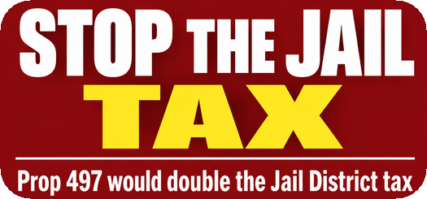
 This campaign opposes Proposition 497, the proposed increase in the Yavapai County Jail District excise (sales) tax. The site footer currently identifies the payer as StopTheJailTax PAC; the committee’s exact registered legal name and official filing details have not been independently verified on this website. This page explains the proposal, the County’s stated rationale, the historical financial figures reviewed, and the questions the published documents do not fully answer.
What Proposition 497 would do
The official ballot description says the proposal would add one-quarter cent ($0.0025) per dollar to the existing Jail District excise tax. The Jail District component would increase from ¼ cent to ½ cent per dollar on taxable purchases. If approved, the increase would begin July 1, 2027, and continue for 20 years.
Illustrative added tax
| Taxable purchases | Additional tax |
|---|---|
| $100 | $0.25 |
| $500 | $1.25 |
| $1,000 | $2.50 |
These examples assume the full purchase amount is taxable and show only the proposed additional Jail District tax. The increase doubles that tax component, not necessarily the total sales-tax rate on a purchase.
Why we oppose the increase
Our concern is that a 20-year tax commitment should be supported by understandable projections, a clear explanation of the assumptions, and transparent reporting of results. The County’s published ballot description identifies estimated future revenue needs of $41.44 million per year, $8.88 million in General Fund maintenance-of-effort support, and an additional $16.15 million in General Fund support. These are the County’s stated figures and rationale, not independently verified forecasts presented by this committee.
What a YES vote means
The official ballot description states that a YES vote approves the additional one-quarter-cent Jail District excise tax. If approved, the increase would begin July 1, 2027, and continue for 20 years.
What a NO vote means
The official ballot description states that a NO vote rejects the proposed increase. A NO vote does not itself select a replacement funding source or eliminate existing Jail District expenses. Future funding decisions would still need to be addressed through the County’s budget and policy process.
What the historical financial report shows
The County’s FY2024–25 Annual Comprehensive Financial Report records $17.131 million in total Jail District Fund revenue and $32.923 million in expenditures for the fiscal year ended June 30, 2025. Expenditures exceeded revenue by $15.792 million before transfers and other financing items. The schedule records $17.814 million in transfers in from the County General Fund, $4.313 million in transfers out, and a closing fund balance of $945,559.
These are historical figures for one fiscal year, not the same as the County’s future $41.44 million estimate. They show the reported funding pattern for that year but do not establish that the proposed tax increase is the only possible response or predict exactly what would happen after a YES or NO vote.
Questions the public deserves to have answered
- What calculations and assumptions support the $41.44 million annual future revenue estimate?
- Where is the detailed year-by-year projection for the proposed 20-year period?
- How are staffing, operations, medical and mental-health services, facilities, debt service, inflation, and population changes reflected in the forecast?
- What funding alternatives were evaluated, and what would each mean for taxes, services, and the General Fund?
- How would any claimed property-tax benefit be calculated and reported to residents?
- What annual public reporting would allow taxpayers to compare forecasts with actual costs and revenues?
These are questions for public review, not allegations of wrongdoing. Where the documents reviewed do not answer a question, this page identifies it as unresolved rather than assuming an answer.
What the County says about visitors and property taxes
The County’s public funding explanation says approximately 20% of incarcerated individuals are from outside the area and approximately 20% of sales tax is paid by visitors from outside the area. It also claims tourism reduces the tax burden by $1,155 per household annually and says approval would ease General Fund pressure and allow lower property taxes. The County page reviewed does not provide the underlying calculation for the $1,155 figure or guarantee a specific property-tax reduction for an individual household. These statements are therefore presented as County claims, not guaranteed outcomes.
Source summaries and original documents
These summaries are provided for convenience; readers can compare them with the primary documents:
- Yavapai County — official Proposition 497 ballot language: the proposed tax, duration, County estimates, and formal effect of YES and NO votes.
- Yavapai County — Jail District funding explanation: the County’s rationale, visitor-spending statements, and potential property-tax effect.
- Yavapai County — FY2024–25 Annual Comprehensive Financial Report: historical fund revenue, expenditures, transfers, and ending balance.
- Yavapai County Elections — sample ballots and Proposition 497 publicity pamphlet: official ballot materials.
- Arizona Citizens Clean Elections Commission — Yavapai County guide: voter-education information for the November 3, 2026 election.
Official ballot description: States the tax change, start date, 20-year duration, the County’s estimates, and the formal effect of YES and NO votes.
FY2024–25 Annual Comprehensive Financial Report: Reports the Jail District Fund’s actual revenue, expenditures, transfers, and fund balance for the year ended June 30, 2025.
Citizens Clean Elections Commission voter guide: Lists Proposition 497 as a countywide local measure on the November 3, 2026 General Election ballot and summarizes election dates.
Reviewed October 9, 2026. This page distinguishes official statements, historical accounting, and campaign analysis. Current official ballot, financial, and election information controls if updated.